School · Families
Families
In this conception of school, the presence of families is very important, as is their involvement and collaboration to the extent that each feels comfortable.
- Communication with the teaching team
- By email and at morning drop-off or pick-up.
- Meetings
- Pedagogical meetings for the whole school, process meetings for each cycle and individual tutorials.
- Keeping up to date
- A weekly newsletter.
- Participation
- In activities and celebrations, in committees and working groups, and through tasks to maintain and care for the spaces.
- Platform
- gestio.espai-aigua.org
Self-management and collective commitment
Espai Aigua is a non-profit, self-managed association. Our educational project is built on collective commitment and the active participation of all member families. This way of organising ourselves lets us sustain an innovative, well-cared-for and accessible educational project based on trust, cooperation and shared responsibility.
Read more
The Associació Espai de Criança AIGUA is a non-profit association whose only source of income is its members’ fees.
It is essential, however, that there be a commitment to the educational project and its principles, so that children are accompanied coherently, giving great weight to the bonds created both with the children and with the families.
Family–school communication
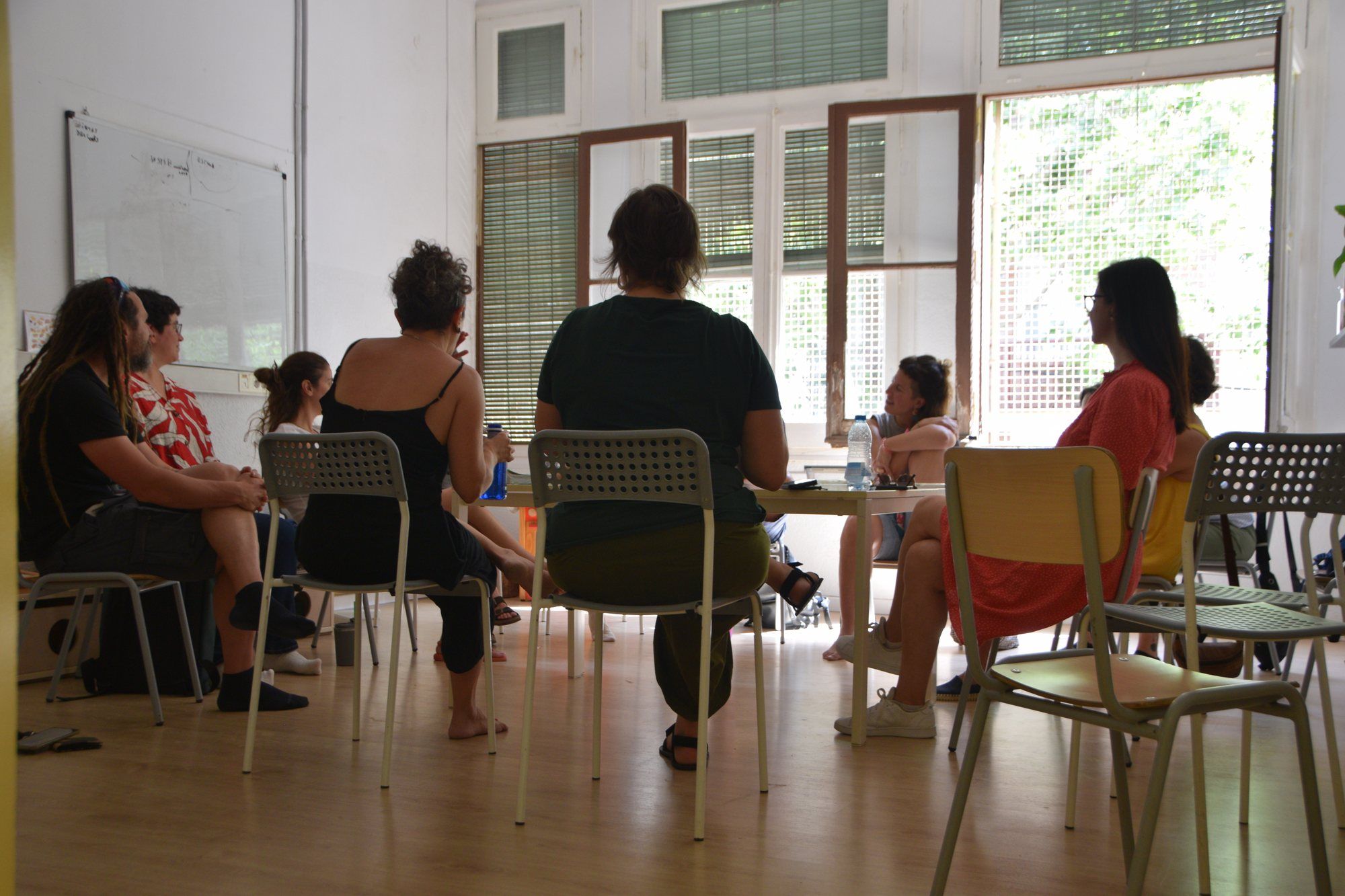
We see the relationship between family and school as an essential part of accompanying children. We want to build close, fluid communication based on trust, which allows us to share outlooks, concerns and relevant information and helps us make decisions together for the benefit of each child and of the community.
Read more
Throughout the year there are different spaces where families and the school team meet. Some are collective and allow us to share matters that affect the group or the stage, while others focus on each child’s particular process.
At the start of the year there are group meetings, in which general aspects of how things work, the dynamics and the processes planned for the year are shared. Over the year, further cycle meetings are also called to share the processes under way. Every term there are also pedagogical meetings on topics that may be of common interest to the whole school.
At least twice a year, individual tutorials are arranged with the family, to share significant aspects of a child’s process, make decisions together or go deeper into a matter that calls for a view shared between family and school. These meetings make it possible to pool the observations of the people who accompany the child and to agree, when necessary, on ways to keep accompanying them. In addition, two descriptive, qualitative reports are sent, one in December and one in June–July.
Besides these meetings, we try to make room for direct, informal communication in everyday life, especially at drop-off and pick-up, when a short conversation can be enough to share a piece of information, make a comment or notice the need for a longer conversation.
Communication also continues through different written channels. Email allows us to share information, ask questions and keep up a more unhurried communication when there is no need to meet in person. We also have the school’s management platform, which centralises more organisational communications and information and makes day-to-day management easier.
Finally, general assemblies are also held, where decisions about the state and continuity of the project are taken as members.
To keep families up to date with the children’s day to day, a newsletter is sent to all families every week, different for each cycle, with information about the week ahead.
In addition, the school’s private blog, for families only, is updated periodically, sharing moments and projects from each cycle through short texts, photos and videos.
You can also follow the project’s general news on Instagram (@espaiaigua) and find more detailed information on the school’s website (espai-aigua.org).
Participation and collaboration
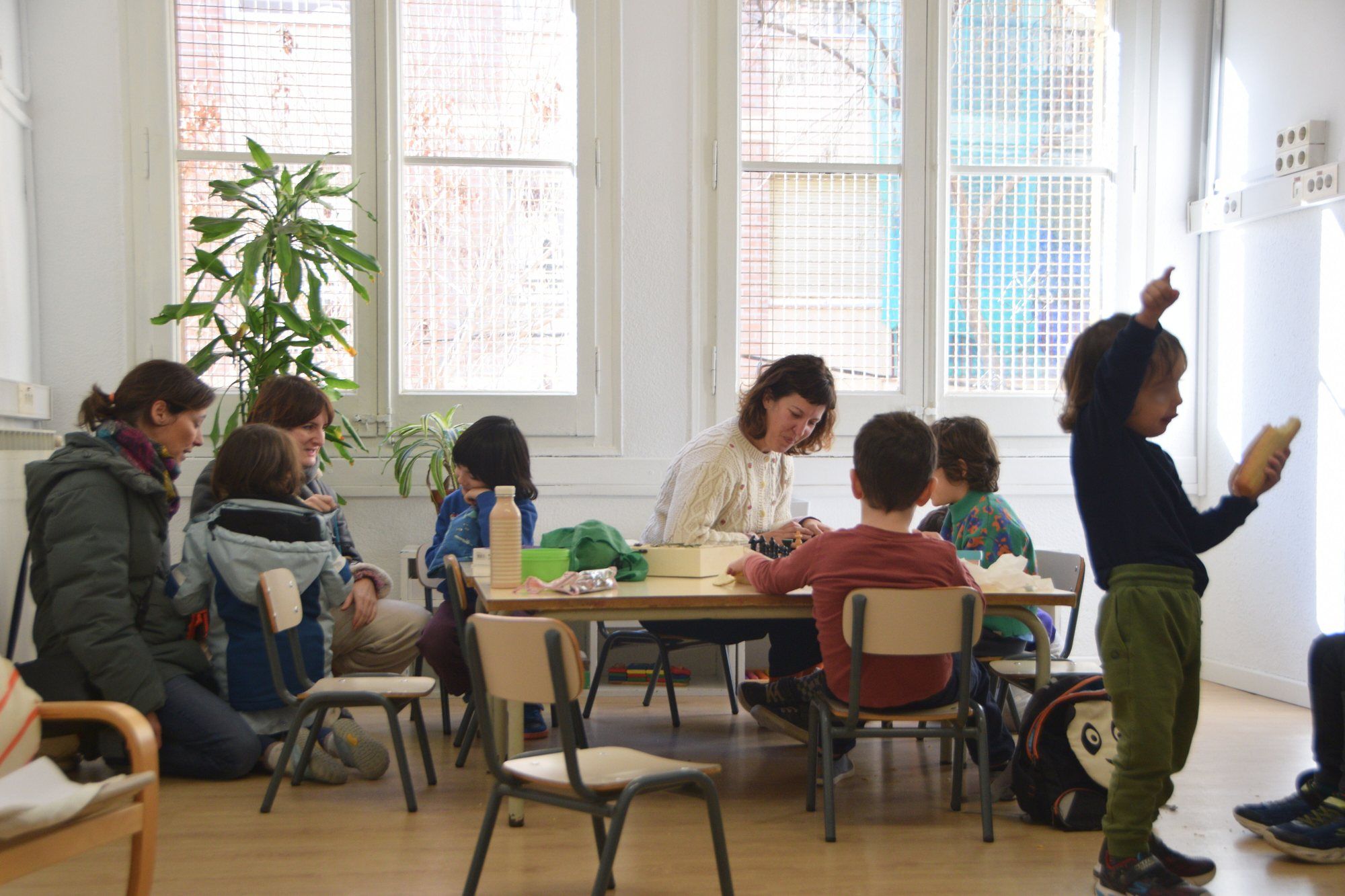
As a self-managed project, it needs the participation of families and the team to sustain itself and function. Families are part of the community and can get involved in different areas of management according to their possibilities and interests. This participation takes many forms, from collaborating on specific tasks to being involved in the day-to-day management of the association.
Read more
Family participation is organised through different spaces and forms of involvement, which respond to the association’s various needs and allow responsibilities to be shared across the community.
Committees are created when a specific project comes up that requires organisation and shared work. They are temporary groups, set up according to the needs of each moment. When the task or project is finished, the committee stops working.
The management working group is a stable space that gives continuity to the association’s day-to-day management. It coordinates and carries out the tasks needed for everyday running and responds to the matters that arise. In this way, management needs do not depend only on one-off moments but are followed up continuously.
Families also contribute through tidying, cleaning and maintenance tasks. They are simple but essential tasks for caring for the spaces we share and making sure they stay in good condition for the whole community.
Finally, as members of the association, families take part in the spaces for collective decision-making. The General Assembly is the main space where information on the state of the association is shared, decisions affecting the whole community are taken and members take part in the association’s own organisational processes.
We understand that not all families can take part in the same way or at the same times, but all of them can contribute, from different places, to sustaining the project and making it work.
Task system
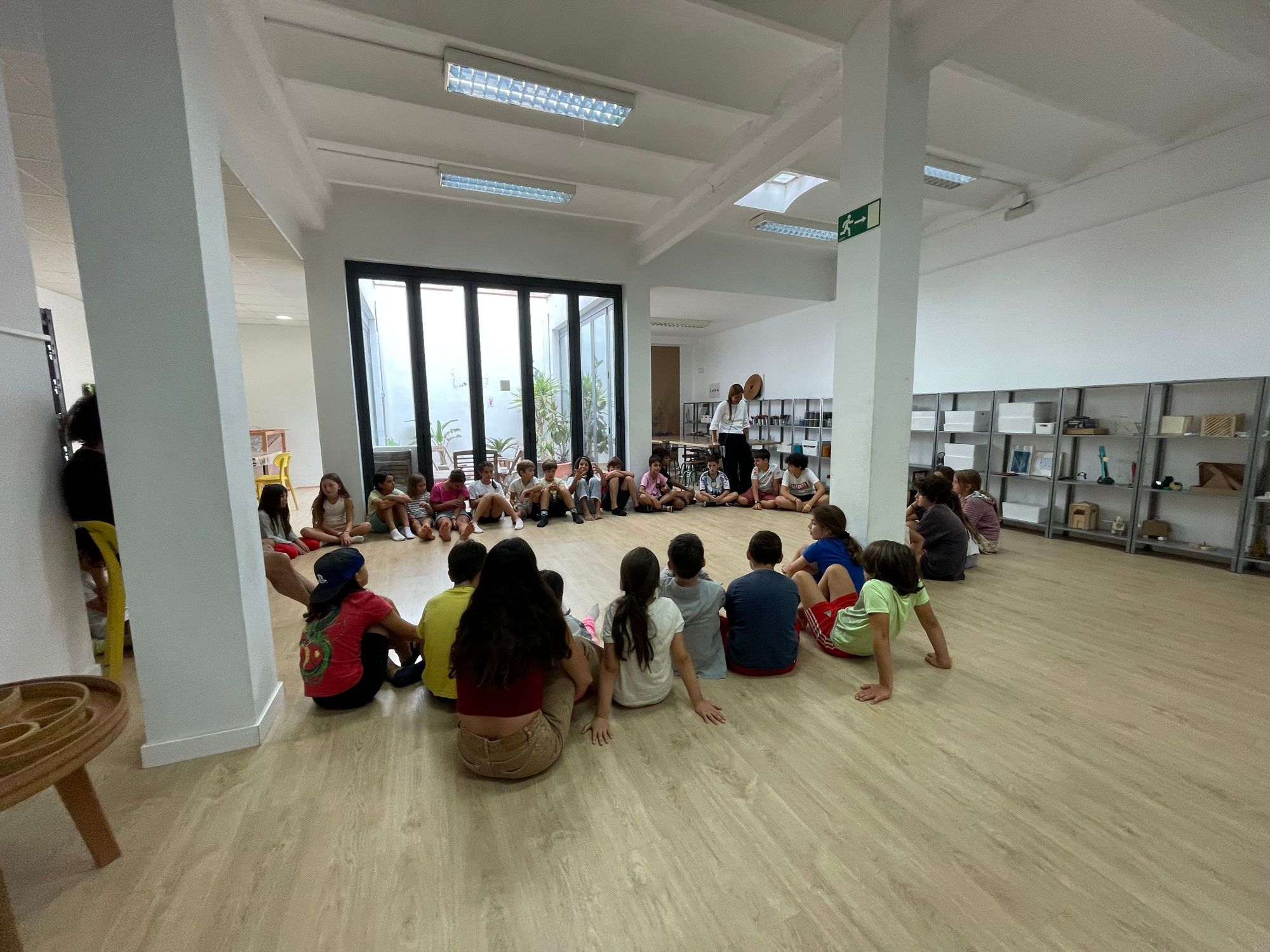
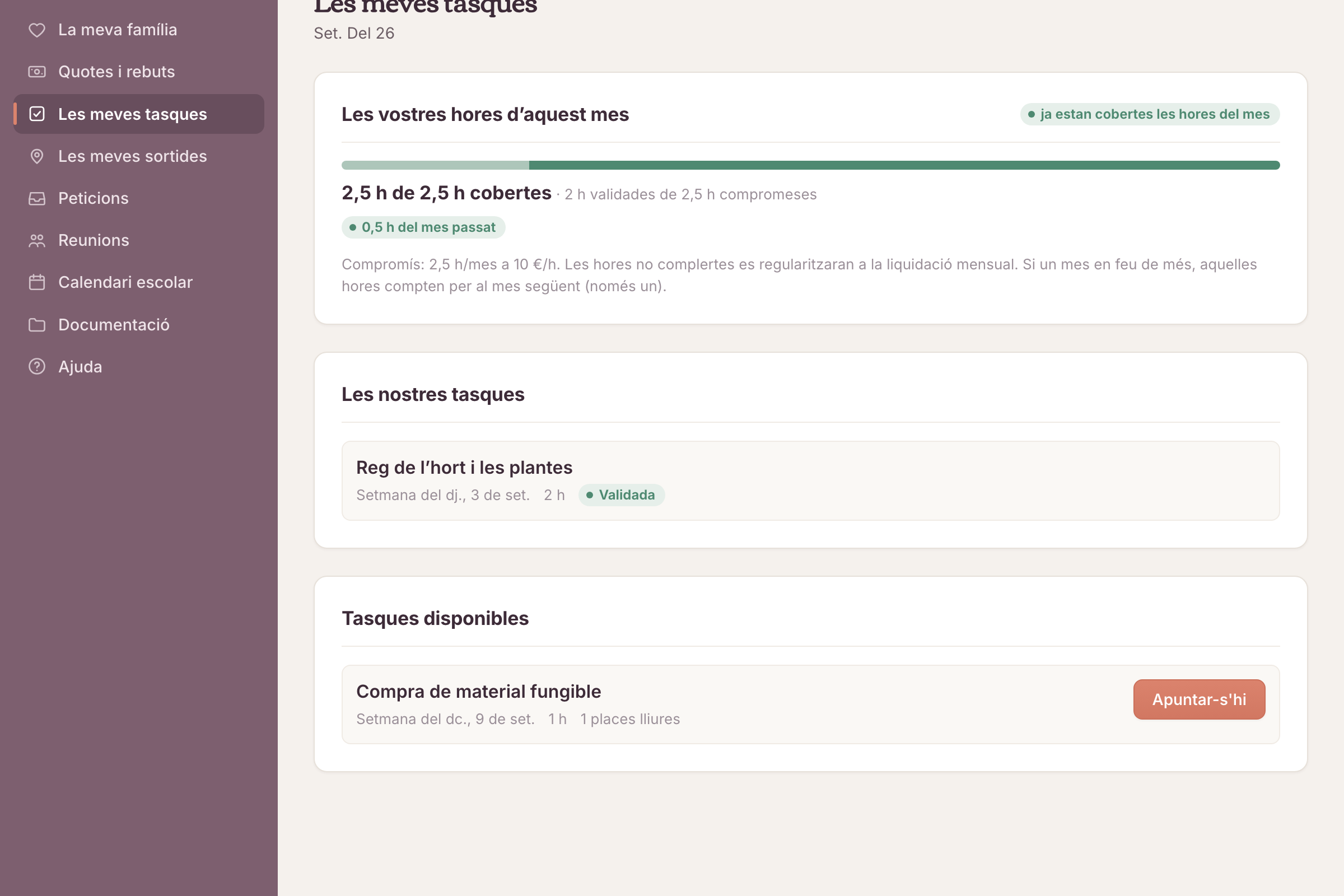
Each member family contributes 2.5 hours a month of maintenance tasks, that is, 10 hours per four-month period:
- 1st period 1 September to 31 December 10 hours
- 2nd period 1 January to 30 April 10 hours
- 3rd period 1 May to 31 August 10 hours
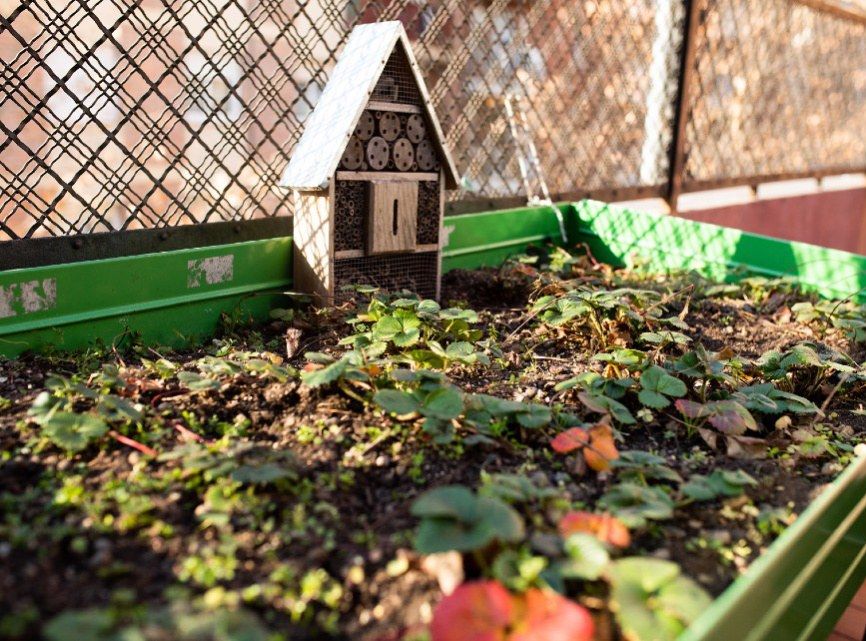
These hours may include tasks such as painting, small repairs, cleaning, gardening, organising materials, etc. Tasks are organised with the support and coordination of the members of the working group in charge of this area.
The available tasks are published on the management platform, where each family can choose and sign up for the ones they want to do. Once done, they mark them as completed and the hours are recorded and validated on the same platform.
Hours are counted per four-month period. Each family has the four months of the period to complete them and can spread the tasks however suits them best over that time. As long as there are tasks still to be covered, any available task can be chosen, even if this means going over the committed hours. When a new four-month period begins, the hour count starts again from zero.
Financial compensation
The task system helps make fees a little more affordable for families. Each hour of participation represents a task that the association does not have to hire out. At the same time, this system strengthens the community, as we share responsibilities and work together to care for a space that belongs to all of us. It also has educational value: we pass on to the children the value of collaboration, shared responsibility and caring for the spaces we share.
Read more
This count includes both maintenance, cleaning and organisation of the spaces and participation in the association’s working groups and committees.
So when a family cannot complete the 10 hours of tasks assigned to it, the part not done is compensated financially, at €10 per hour. At the close of each four-month period (31 December, 30 April and 31 August) the difference between the committed hours and the validated hours is calculated and, where applicable, the corresponding receipt is issued.
This contribution covers the tasks and services that families have not been able to take on, keeping the project financially balanced.
Would you like to be part of it?
Enrolment is open all year round. You can contact us to come and get to know us.
Request a visit