School · Educational project
Educational project
Ours is a living educational project that seeks to open up new possibilities and explore ways of understanding education, exploring paths that cross other disciplines, forms of knowledge and outlooks. We do so from a pedagogy that is sensitive, attentive to people and processes, and critical, willing to question the beliefs and truths we have inherited and often take as unquestionable.
Key concepts and references
Our main goal is for children to grow up respected, loved, understood and accepted; to unfold wherever and however they wish, so as to feel at ease with themselves. At the same time, we work so that each of them develops their own resources, allowing them to adapt to what the context requires without giving up a critical, transformative outlook in which they find answers to their own concerns. An attitude closely linked to effort, autonomy and cooperation, and to the ability to imagine new constructions and ideas.
Read more
There is broad agreement that our education system needs to be renewed and rethought. Ours is a project immersed in this intense and fascinating process of research, reflection and putting into practice new educational proposals that are continually being created and transformed. Even so, many of our experiences were already thought through and lived by other reformers who fought for their projects as we do now for ours: R. Wild at the Pesta, C. Freinet in the cooperative schools, M. Montessori with her method, L. Malaguzzi in the Reggio Emilia schools, A. S. Neill at Summerhill.
On this basis we commit to an educational paradigm centred on processes, on the construction of one’s own learning and on the indispensable emotional accompaniment. One in which contents and objectives no longer hold the relevance or legitimacy they acquired over so many years of educational programmes aimed at other interests, goals, realities, contexts and socio-political demands. On this basis we nurture a more autonomous and open kind of learning, one that gives priority to the overall, harmonious growth of the person and that generates more solid and genuine structures. These structures constantly connect what we do with what we feel and think, without dissociating them. And, above all, we make sure that this new outlook is based on unconditional respect for childhood, life and freedom (A. S. Neill, founder of Summerhill).
Generating new alternatives is intense creative work. We would all like to find the perfect technique or method that answered every developmental need of children and of society and the community, whatever their approach. But we are well aware that this is not possible; it will always be unfinished work, because those needs and interests are constantly changing and transforming. So teachers and educators, like the families involved, must live in the process, in practice, in review, observation, self-criticism and change; in a continuous, committed creation in action. It is in this reflective practice (Stenhouse) that we keep finding answers to all these tensions and questions that arise from our disagreements with the system’s approaches.
Fortunately, we are not starting from scratch on this path. Vygotsky said that creativity consists in building the new by restructuring the old. And it is in this process that we feel our ideas, the fruit of many years of work, observation, imagination and experience, are accompanied by the ideas and testimony that others have left us.
That comforts and reaffirms this daily work, which seeks to create other points of view, structures and techniques in relation to schools and the official curricula. But above all, another way of looking at childhood, at its development and its authentic needs (R. Wild). A more sensitive, more respectful, more open, more intuitive and imaginative gaze. And that requires rethinking our roles, positions and relationships as educators and teachers with respect to children and their learning processes.
We draw on previous experiences while still looking towards what we do not yet know. We are not looking for a closed formula, but for a project capable of reviewing itself, because we see it as a space of shared research that transforms as we do.
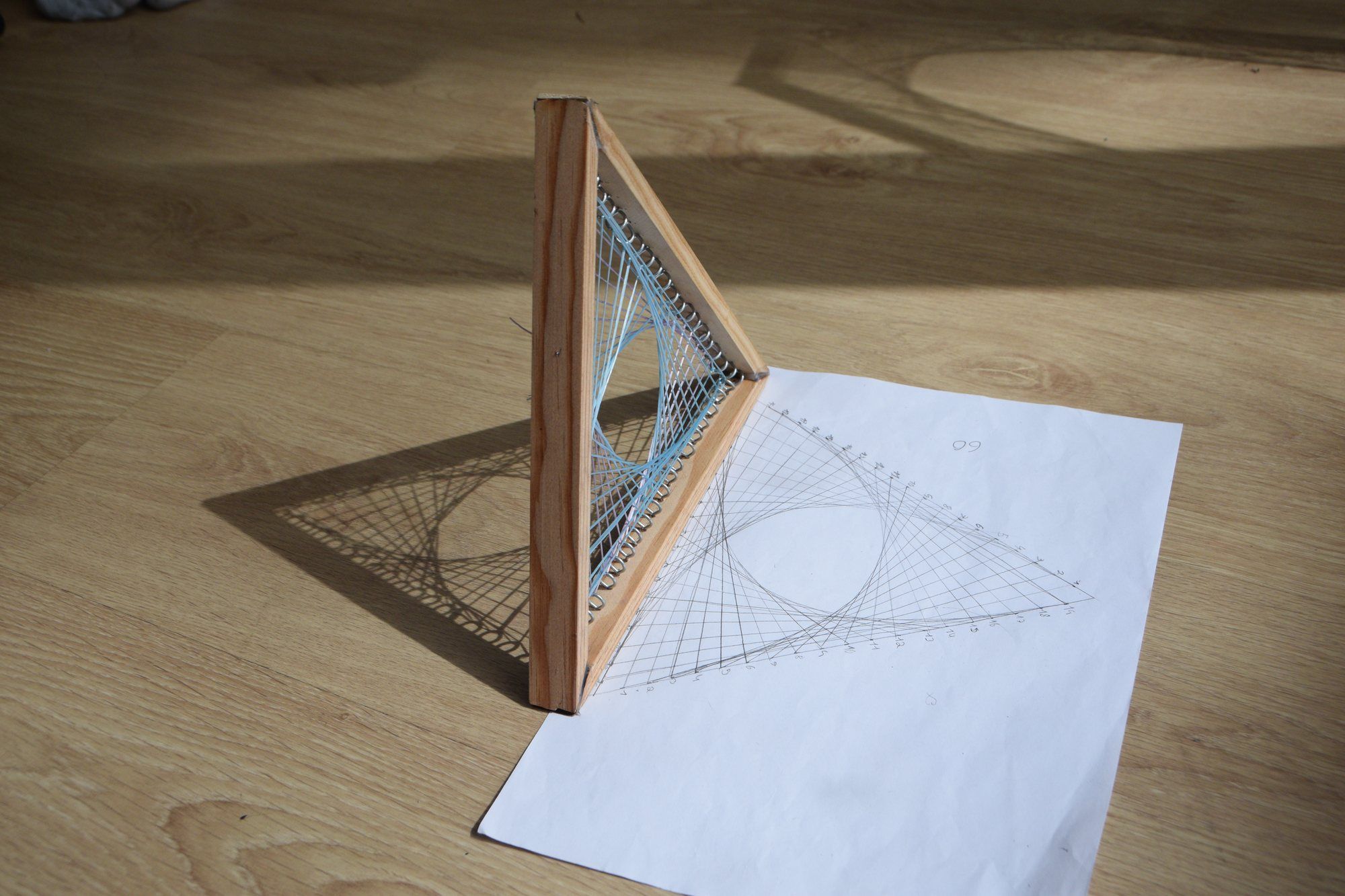
Sensitive pedagogy
We are adults who care for and accompany, who look for ways to move forward together, who see not difficulties but opportunities, not mistakes but attempts, who do not judge but listen. Who see in every uncertainty a chance to grow.
Read more
If there is one trait we want to run through every one of our interventions, investigations, observations, proposals and, in general, our daily practice, it is sensitivity. We need it to listen with our whole body to every message children and their families send us; not to miss the information that is not put into words, which is a great deal and very significant; to listen carefully to what our coherence and our intuition tell us, and not only to our knowledge and the learned structures of what “is” or may come to “be” through reason.
We are completely open, ready to face whatever may happen, which in these contexts is usually the most unexpected and surprising. We open ourselves to the children and their world from listening and understanding, to try to grasp what is going on, what lies behind a behaviour, some words, an attitude, a pain or a block. We want to know each other without so many imposed filters, to trust each other and share, looking at and feeling each other honestly.
Sensitivity is also very present in another approach closely linked to learning: the sensory one. We relate to the world through the senses, all of them, and it is through them that we understand and grasp the world. The more senses are involved in approaching and discovering the world, the richer the contributions and information will be, and the better the new neurological connections.
A sensitive pedagogy is also a way of understanding our relationship with the world. It invites us to look carefully at what surrounds us, to recognise the rhythms of nature, bodies, materials, spaces and other living beings, and to understand that we are part of a web of relationships and interdependencies.
From this ecological outlook, we do not only want to teach how to care for the environment, but to learn to feel part of it. Observing, knowing, inhabiting and transforming our surroundings also means asking ourselves how we treat them, what we take from them and what we leave in them.
We want to stress the importance we give to art, understood as a way of looking, of educating sensitivity and of giving it a relevant place in study, research and the acquisition of new knowledge. A sensitive gaze that makes it possible to approach the world through different filters, without confining it to rationality. Perception through all the senses, subjective interpretation, learning with the body, appealing to emotions and intuitions: all these open up new interpretations and discoveries in every field, even those that seem far from these ideas, such as science.
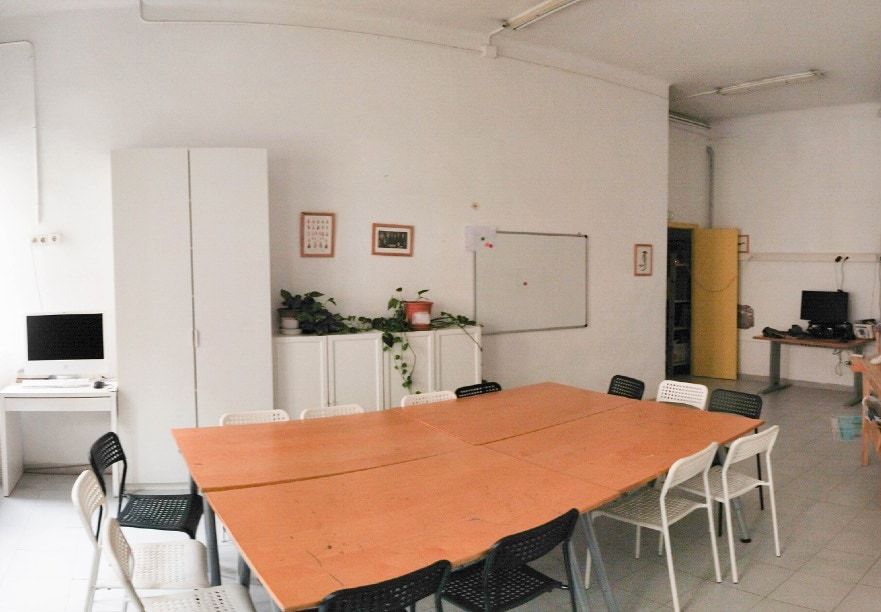
Learning by doing
The foundations of active education are equally part of our daily practice. They are summed up in the concept of learning by doing, as J. Dewey explained: children come to school to do. To do in relation to their present life, not as training for what they may or may not encounter in the future.
Read more
Any activity or proposal should consist largely, if not entirely, of handling and creating, so that learning is as complete and satisfying as possible. Merely listening, reading and writing drastically reduces the channels through which information enters, the relationships and associations that are created, and the level of motivation, attention and fun (D. Bueno). Because something we consider fundamental is often forgotten: learning is great fun and very satisfying. It generates well-being, it is pleasurable and it gives meaning to our efforts.
That is why we focus on building knowledge from children’s own experiences and interests, so that motivation and emotion, essential to learning, are always present. Accompanying the creation of their own unique structures from within, in interaction with the world around them, as J. Piaget explained and studied. In this way we make sure that new learning is properly integrated into existing structures and connections in order to create new ones.
How do we help these processes to be pleasurable, fun and meaningful? By letting each child choose their own routes, gaining autonomy and developing the capacity for choice. The role of the accompanying adult, educator, teacher… comes closer to that of facilitator, guide, tutor, provocateur…, designing these personal itineraries together; making sure (through a very broad, interconnected gaze and listening across all the processes taking place) that children build their own learning, respecting their styles and taking the weight off the result. Mistakes are not only not penalised, they are an indispensable part of the process.
Our proposal seeks to approach the school curriculum through, among other things, STEAM interdisciplinarity (science, technology, engineering, arts and design, mathematics), erasing the artificial lines that divide knowledge into areas so as to approach it from a holistic, interrelated perspective that fits the real world. Likewise, and just as transversally, it is always shaped by the gender perspective and by awareness of sustainability and the climate emergency, with an ecological and feminist vision. And all our practice is approached from the new paradigm of neurodivergence, with a new proposal: “non-exclusion”.
Art gives us room for imagination, fantasy, transformation and the dissolving of limits. Art is the frame, the space in which all other relationships take place. Aesthetics, design, narratives, staging, bodily expression, music, poetry, inspiring references… bring us to knowledge through emotion, and it becomes authentic and vibrant.
Finally, we also need to foster a collaborative, generous working environment, in which age does not make us experts or apprentices: our position shifts with each project.
In this way children learn to be autonomous in their processes, to manage their time, to reflect so as to learn from their mistakes, removing the stigma from them and valuing them as an indispensable part of the process. They also learn to overcome frustration, to resolve conflicts and to work as a team. To find their own concerns, passions and motivations, and to recognise the unique potential each of us has.
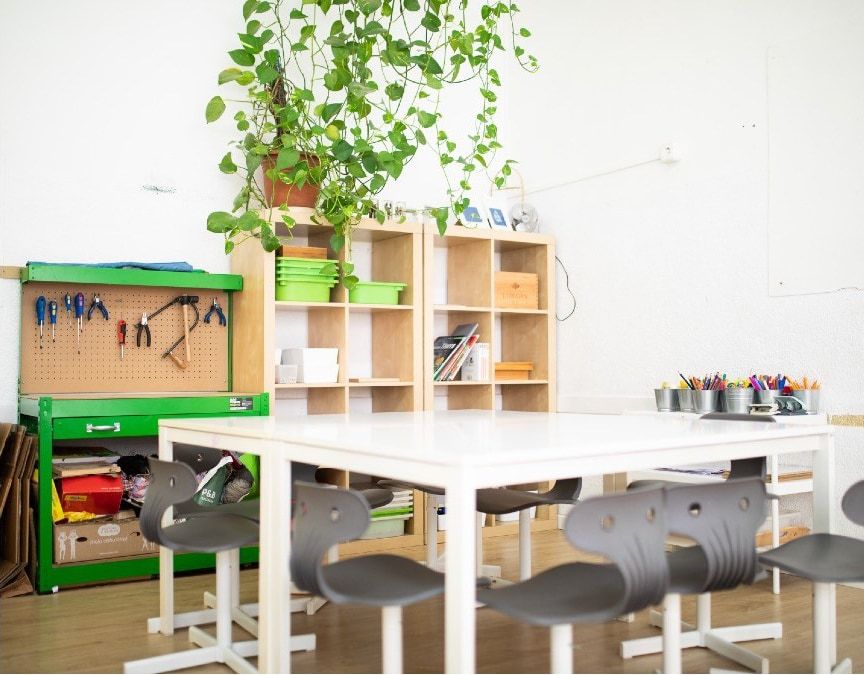
School, a place of life
School is not a place of preparation for later life; it is in itself a place of life (J. Dewey). A present, in a specific context that shapes our daily activity and our perspectives.
Read more
We are not held hostage or conditioned by all the problems that might come. We enjoy now; we need to find meaning during these years, because that gives us a solid, true foundation for whatever may come. We do not prepare: we grow, share, build. We grow into whole people, in every facet, not only the academic one.
In our view, school should be a bounded, cared-for environment in which experiences of social life can take place. Social life at school is based above all on exchange through communication between individuals, and on resolving the conflicts that arise from living and interacting together. These social norms are broad and have different codes, all equally valid.
We therefore try to ensure that everyone feels at ease in their place, while also keeping in mind the well-being of the group and of the whole community. As Dewey said, it is a matter of helping children and adults to develop, creating in them a desire for continuous growth, to go on learning, and of helping each one find their own happiness in improving the conditions of others.
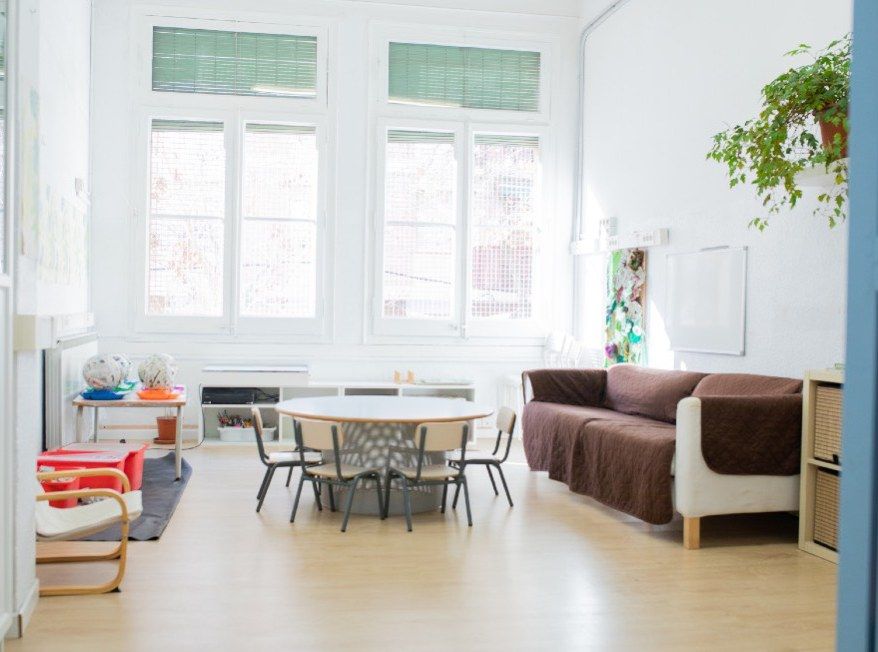
Limits and living together
One of the confused ideas that often arise on first approaching free pedagogy is that children have absolute freedom to do whatever they please at all times. The name certainly invites the misunderstanding, but in reality that idea does not describe our principles or the reality of our school.
Read more
We speak of a freedom that is not only individual but always takes into account the other person and their freedom, the group and the community. A freedom in which we all, adults and children, feel comfortable and at ease in our place; each with very clearly defined and delimited responsibilities and roles.
In addition to the rules of coexistence, we obviously need rules about safety: that of the space, of others and of oneself. We adults take charge of them: we are responsible for making sure these limits are always present.
Violence is not allowed under any circumstances or on any pretext. Nobody may ever be hit or insulted. That does not mean it never happens. And as they grow, new agreed rules appear among the children that greatly relax relationships: we don’t lie to each other, we don’t blackmail or manipulate, we don’t threaten. Of course anger, aggressiveness, conflict, disagreement and personal clashes are allowed, in all their intensities; but always expressed and channelled within these rules.
In these conflicts, adults keep a low-intervention role as regards the content and resolution of the conflict. Children have to find their own solutions; ours will only help them for a moment. We step in when one of these safety or coexistence rules is not respected, reminding them how necessary they are for oneself and for the other.
Conflict is not something to be avoided; on the contrary, it is an opportunity for growth and for developing new personal resources. Conflict management is very present in daily life, and meetings are a much-used space for airing disagreements, discomfort… and for sharing among everyone how we handle these emotions, how we reach agreements or look for new rules.
Rules that also help us keep order and care for the space, the materials and other people’s creations. Everything we use must be put away when we finish; materials are treated with care and, if something breaks, it must be repaired; someone who is working or playing must not be interrupted or disturbed in what they are doing; we clean and tidy the rooms every day; we water our plants and, together, we look after our school.
This order, as Maria Montessori explained, is not merely aesthetic: it is the order children need to be autonomous in the space, getting on in it without constantly needing an adult’s help. It is fundamental that they master their surroundings and feel them to be entirely their own.
Most of the time the adult reminds the particular child of these rules in the moment. When they are small, many of them have to be repeated very often, until they are integrated into how they act. The rules on safety and respect, such as not hitting, insulting or attacking anyone else, are conveyed clearly, stating very explicitly that such behaviour is not allowed in our space.
After such a clear limit, the child inevitably feels a pain that we console and hold with affection, understanding the emotion that overwhelms them, but without sparing them that pain and frustration. These limits give them security, containment and shelter so that they can move freely within these spaces without violence or threats. When they feel overwhelmed, we contain them, trusting in ourselves and in them. Each in their role, without confusion.
Feminist education
We stand for an education in which all expressions are equally valid and recognised. In which care is at the centre of relationships, and relationships are at the centre of a society that takes care of itself in order to move forward.
Read more
Coeducation is the basic principle that must guarantee the participation and development of all people without distinction, and it must become an essential tool for building and developing an egalitarian community. In our educational project in particular we have decided to keep this principle always in view, so as to offer an education that really allows our pupils to develop freely, without the conditioning, limits and obstacles that stereotypes and roles impose when it comes to choosing how we are, what we want to do and how we relate to ourselves and to the world. Stereotypes hold back personal development the moment they restrict how we should be or act, or what we should expect (or what is expected of us). Also when they force us to follow patterns, behaviours and attitudes we have not chosen (although it may seem to us that we have) and which we merely reproduce automatically. Coeducation benefits everyone, because it opens up the possibility of feeling truly at ease with oneself. It liberates.
The androcentric perspective, along with the Eurocentric, racist, colonialist and ableist ones – still present in contents, language, teaching methods and our own attitudes – must be overcome. A path has been started that still has a long way to go, but that leads towards a community in which everyone feels equal, a reality we do not yet live. There is a need to know and to teach the role of women in building civilisations and to recognise their contributions in every field of knowledge and creation. We have begun a process of reflection and action to detect and remove from our daily life stereotyped and sexist comments, attitudes and contents, analysing the curricula (both explicit and hidden) and giving the team tools to become new references for a fairer, more egalitarian and freer model.
We work to create spaces in which new masculinities, femininities or other gender expressions can develop, so that everyone feels comfortable and safe. We strive to give children a healthier and more coherent view of sexuality, so that relationships with bodies are also based on care and respect (towards oneself and towards others). Spaces of care in which violence (including the invisible, socially accepted kinds), in any of its expressions, must be limited.
The team has for years been engaged in deep work to become these new models, to walk towards these goals and to make the changes that will let us speak of a more authentic freedom for everyone.
Coeducating means overcoming the power relations that subordinate one sex to the other, and incorporating on equal terms the realities, history and culture of all people in order to act with equity. It also means working to prevent abusive behaviour and to foster non-violence in interpersonal relationships.
Non-exclusion
We are all included from the moment we are born. Diversity is not accepted: it simply is.
Read more
We understand non-exclusion as a commitment to building a community in which everyone can belong without having to give up who they are. We do not seek for everyone to fit into a single way of doing, learning, relating or taking part, but to create the conditions for each person to find their place and develop within the collective.
This means recognising that we have different rhythms, abilities, interests, ways of communicating and needs, and that these differences should not become a reason for separation or exclusion. That is why we try to make structures, proposals and environments the ones that can adapt to people, and not the other way round. We make groupings, time, spaces, materials, forms of participation and ways of reaching learning more flexible when necessary.
Non-exclusion also has to do with being able to take part in collective life from different places. We do not always need to do the same thing, or in the same way, to feel part of a group. We listen to each child’s needs and look for alternatives that allow them to keep their bond with the collective, even when they need to step away from a proposal for a while, change its conditions or find another way to take part.
Accompanying difference does not mean avoiding conflicts or removing the difficulties that arise in living together. It means having tools to understand them, put them into words, look for solutions and accept that being part of a community also means learning to live with what we feel is different from us.
Download the project summary
The summary of the 2026-27 Educational Project (17 pages) in Catalan, Spanish or English. Leave us your email and we will unlock the download.
Come and visit
Enrolment is open all year round. If you would like to get to know the project, you can contact us to arrange a visit.
Request a visit